Archive for the 'NMR' Category

Computed NMR chemical shifts with multiple standards

In order to obtain computed NMR chemical shifts, one computes the isotropic magnetic shielding tensor and subtracts this value from that computed for a reference (or standard) compound. Typically, one uses TMS as the standard. Sarotti and Pellegrinet have questioned whether this is a reasonable approach.1 Since computational methods vary in quality with methodology, basis set, geometry – one might wonder if the use of a single standard for all computed chemical shifts is the best approach.

They computed the 13C chemical shielding tensor for 50 organic compounds possessing a wide variety of functional groups and rings – a few examples are given below. They also computed the 13C chemical shielding tensor for 11 different simple organic compounds that might be used as NMR references (like TMS, benzene, methanol, and chloroform).

By comparing the computed chemical shifts obtained using the different references and then matching them with experiment, they propose a multi-reference method. For sp3 carbon atoms they propose using methanol as the reference, and for sp2 and sp carbons using benzene as the reference. With chemical shifts computed at mPW1PW91/6-311+G(2d,p)//B3LYP/6-31G(d) using the multi-reference model , the average mean difference from experiment is 2.1 ppm, less than half that found when TMS alone is used. The average RMS deviation of 4.6ppm is about half that when TMS is used as the sole standard.

Though the authors mention the solvent effect on chemical shifts, it is surprising that they did not include solvent in their calculations, especially since they are comparing to experimental chemical shifts in deuterochloroform. Nonetheless, I think this is a nice idea and further exploration of this concept (multi-reference fitting) is worth further pursuits.

References

(1) Sarotti, A. M.; Pellegrinet, S. C., "A Multi-standard Approach for GIAO 13C NMR Calculations," J. Org. Chem., 2009, 74, 7254-7260, DOI: 10.1021/jo901234h

NMR Steven Bachrach 11 May 2010 2 Comments

NMR shifts of aromatic and antiaromatic compounds using BLW

The chemical shift of the benzene proton is about 7.3ppm, significantly downfield from the range of olefinic protons (5.6-58.ppm). This is rationalized as the standard induced diatropic ring current, found in aromatic species. But what should we make of the chemical shift of the protons in cyclobutadiene at 5.8 ppm? Shouldn’t this be much further upfield?

Schleyer and Mo have applied the block localized wavefunction (BLW) technique to aromatic and antiaromatic chemical shifts.1 In BLW, self-consistent localized orbitals are produced to describe a particular resonance structure. So, for benzene, BLW describes in effect 1,3,5-cyclohexatriene, lacking any resonance energy.  When chemical shifts are computed with the BLW description, the proton chemical shift is 6.6 ppm, and is even more upfield if the geometry is optimized (in D3h symmetry) with the BLW method (δ=6.2ppm). Furthermore the NICS(0)πzz (the tensor component corresponding to the perpendicular direction evaluated in the ring center using just the π orbitals) is -36.3 for benzene and 0.0 for the D3h BLW variant, strongly indicating the role of cyclic delocalization in affecting chemical shifts.

Now for cyclobutadiene, the proton chemical shift of 5.7 ppm becomes 7.4 in the BLW case. NICS(0)πzz for cyclobutadiene is +46.9 and +1.6 in the BLW case. The problem is that typical alkenes are poor references for cyclobutadiene – when resonance is turned off, the chemical shift does move downfield – indicating the expected upfield shift for cyclobutadiene. Schleyer and Mo suggest that 3,4-dimethylenecyclobutene is a more suitable reference; its ring protons have chemical shifts of 7.65ppm.

They also describe computations of benzocyclobutadiene and tricyclobutenabenzene and offer straightforward rationalizations of their aromatic vs. antiaromatic behavior.

References

(1) Steinmann, S. N.; Jana, D. F.; Wu, J. I.-C.; Schleyer, P. v. R.; Mo, Y.; Corminboeuf, C., "Direct Assessment of Electron Delocalization Using NMR Chemical Shifts," Angew. Chem. Int. Ed., 2009, 48, 9828-9833, DOI: 10.1002/anie.200905390

InChIs

benzene: InChI=1/C6H6/c1-2-4-6-5-3-1/h1-6H
InChIKey=UHOVQNZJYSORNB-UHFFFAOYAH

cyclobutadiene: InChI=1/C4H4/c1-2-4-3-1/h1-4H
InChIKey=HWEQKSVYKBUIIK-UHFFFAOYAI

3,4-dimethylenecyclobutene: InChI=1/C6H6/c1-5-3-4-6(5)2/h3-4H,1-2H2
InChIKey=WHCRVRGGFVUMOK-UHFFFAOYAP

Aromaticity & NMR & Schleyer Steven Bachrach 04 May 2010 No Comments

A new approach to NMR structure prediction

I have written many posts on the use of computed NMR shifts as a tool for determining molecular structure, especially stereochemistry. All of these methods rely upon computing a bunch of alternative structures and then identifying the one whose chemical shifts (1H and/or 13C) match up best with experiment. Many people have been interested in the first part of this process – the “computing a bunch of alternative structures” – testing the QM method, the basis set, the selection of conformation(s), and the method for computing chemical shifts. The subject of this post is the notion of “matching up best” and comes from of a recent article by Jonathan Goodman.1

So in the typical procedure for deciding which structure (of many) best accounts for the experimental NMR spectra, the computed NMR shifts (and perhaps coupling constants) are compared to the experimental data. This comparison is done often by simply examining the correlation coefficient r between the experimental and calculated shifts. Some have used the mean absolute error between the computed and experimental shifts. Others have employed a corrected mean absolute error where scaled chemical shifts are first obtained from the plot of the calculated vs. experimental shifts, and then finding the average of the differences between these scaled shifts and the experimental ones.

Goodman suggests that oftentimes what is of interest is not really the chemical shifts of a compound but rather identifying the structure of diastereomers, and then it’s really the differences in the chemical shifts of pairs of diastereomers that are really critical in identifying which one is which. Using Goodman’s notation, suppose you have experimental NMR data on diastereomers A and B and the computed NMR shifts for structures a and b. The key is deciding does A correlate with a or b and the same for B. Goodman proposes three variants on how to compare the chemical shift differences, but I’ll show just the first, which he calls CP1. Define Δexpi as the differences in the experimental chemical shifts of the two diastereomers for nucleus i: Δexp = δAi – δBi and a similar definition for the differences in the computed shifts: Δcalc = δai – δbi. CP1 is then defined as Σ (Δexpcalc)/Σ (Δexp)2 where each sum is over the nuclei i. Goodman shows in a number of examples (some are shown below) that CP1 and its variants provides an excellent measure of when a computed structure’s chemical shifts agree with the experimental values, along with a means for noting the confidence in that assignment. These CP measures provide significantly better measures of agreement that the ones previous utilized, providing a real confidence level in assessing the quality of the prediction. I strongly urge all who are interested in the use of computed NMR in determining molecular structures to read this paper and consider adopting this approach.

References

(1) Smith, S. G.; Goodman, J. M., "Assigning the Stereochemistry of Pairs of Diastereoisomers Using GIAO NMR Shift Calculation," J. Org. Chem. 2009, 74, 4597-4607, DOI: 10.1021/jo900408d

NMR Steven Bachrach 25 Aug 2009 No Comments

Computed NMR – structure of isorunanine and hypurticin

Here are two nice examples of the use of computed spectra in identifying the structure of large molecules.

Castle and co-workers describe the synthesis of what they hoped would be runanine 1.1 However, after they had completed their synthesis, the 1H NMR spectrum of their product differed significantly from that of runanine. Further the optical rotation of 1 is -400, while that of their product is -34. Speculating on what might be the product they came up with 4 alternative structures 2-5. The 13C NMR of 1-5 were then computed by optimizing the structures at mPW1PW91/6-31G* followed by a GIAO computation at mPW1PW91/aug-cc-pVDZ with PCM (solvent is chloroform). The differences between the computed chemical shifts for 1-5 and the experimental shifts of the obtained product are summarized in Table 1. The authors conclude that their product is 5, a compound they name isorunanine.


1
(runanine)


2


3


4


5
(isorunanine)

Table 1. Average difference and maximum difference between the computed and experimental 13 C chemical shifts (ppm).

Compound

Average Δδ

Maximum Δδ

1

9.7

61.7

2

9.3

60.1

3

12.0

54.6

4

10.9

61.8

5

3.8

9.8

The authors also report the rather poor agreement between the computer spectrum of 6 and the experimental spectrum in benzene. Unfortunately, not enough details are provided to really determine where errors might be occurring. For example, there is no indication of examining multiple conformations (and those methoxy groups can rotate along with the inversion at the amine). Once again, the supporting materials, while extensive in terms of experimental NMR spectra, contain no details of the computed structures.

The structure of hypurticin 6 was determined using a comparison of computed coupling constants.2 Here the authors first assumed that four possible stereoisomers are possible 6a-d, given that the other stereocenters were determined unambiguously by experiment and biogenesis considerations. B3LYP/6-31G(d) optimization of a restricted set of conformations led to the lowest energy conformer. The coupling constants computed for these four structures indicated the closet agreement between the computed constants of 6a with experimental values. An exhaustive search of the conformational space of each of these diastereomers at B3LYP/DGDZVP followed by Boltzmann weighting of the coupling constants confirmed that 6a is the structure of hypurticin.

References

(1) Nielsen, D. K.; Nielsen, L. L.; Jones, S. B.; Toll, L.; Asplund, M. C.; Castle, S. L., "Synthesis of Isohasubanan Alkaloids via Enantioselective Ketone Allylation and Discovery of an Unexpected Rearrangement," J. Org. Chem. 2009, 74, 1187-1199, DOI: 10.1021/jo802370v.


(2) Mendoza-Espinoza, J. A.; Lopez-Vallejo, F.; Fragoso-Serrano, M.; Pereda-Miranda, R.; Cerda-Garcia-Rojas, C. M., "Structural Reassignment, Absolute Configuration, and Conformation of Hypurticin, a Highly Flexible Polyacyloxy-6-heptenyl-5,6-dihydro-2H-pyran-2-one," J. Nat. Prod. 2009, 72, 700-708, DOI: 10.1021/np800447k.

NMR Steven Bachrach 29 Jun 2009 No Comments

Computing 1H NMR chemical shifts

Computed NMR spectra have been a major theme of the blog (see these posts). General consensus is that they can be enormously helpful in characterizing structures and stereochemistry, but there has been a nagging sense that one needs to use very large basis sets to get reasonable accuracies.

Bally and Rablen1 now confront that claim and suggest instead that quite modest basis sets along with a number of flavors of DFT can provide very good 1H NMR shifts. They examined 80 organic molecules spanning a variety of functional groups. A key feature is that these molecules exist as a single conformation or their conformational distribution is dominated by one conformer. This avoids the need of computing a large number of conformers and taking a Boltzman average of their shifts – a task that would likely require a much larger basis set than what they hope to get away with.

The most important conclusion: the WP04 functional,2 developed by Cramer to predict proton spectra, with the very small 6-31G(d,p) basis set and incorporation of the solvent through PCM provides excellent cost/benefit performance. The rms error of the proton chemical shifts is 0.198 ppm, and this can be reduced to 0.140 ppm with scaling. The 6-31G(d) basis set is even better if one uses a linear scaling; its error is only 0.120 ppm. B3LYP/6-31G(d,p) has an rms only somewhat worse. Use of aug-cc-pVTZ basis sets, while substantially more time consuming, provides inferior predictions.

The authors contend that this sort of simple DFT computation, affordable for many organic systems on standard desktop PCs, should be routinely done, especially in preference to increment schemes that are components of some drawing programs. And if a synthesis group does not have the tools to do this sort of work, I’m sure there are many computational chemists that would be happy to collaborate!

References

(1) Jain, R.; Bally, T.; Rablen, P. R., "Calculating Accurate Proton Chemical Shifts of Organic Molecules with Density Functional Methods and Modest Basis Sets," J. Org. Chem. 2009, DOI: 10.1021/jo900482q.

(2) Wiitala, K. W.; Hoye, T. R.; Cramer, C. J., "Hybrid Density Functional Methods Empirically Optimized for the Computation of 13C and 1H Chemical Shifts in Chloroform Solution," J. Chem. Theory Comput. 2006, 2, 1085-1092, DOI: 10.1021/ct6001016

DFT & NMR Steven Bachrach 15 Jun 2009 No Comments

Hexacylinol (again)

One more nail in the coffin of the widely disputed Le Clair structure of hexacyclinol is provided by the B97-2/cc-pVTZ/B3LYP/6-31G(d,p) computed proton and 13C NMR for the two “structures” (see my previous blog post for structures and background). These computations1 are at a more rigorous level than those performed by Rychnovsky, and the addition of the proton spectrum helps clearly settle this issue. Rychnovsky’s structure is the correct one – the mean absolute error between the experimental and computed structure is half that for Rychnovsky structure. The computed coupling constants also are in much better agreement with the Rychnovsky structure. So, Bagno’s contribution accomplishes, I hope, two things: (1) convinces everyone that DFT NMR spectra can be an important tool in identifying natural product structure and (2) closes the book on hexacylinol!

References

(1) Saielli, G.; Bagno, A., "Can Two Molecules Have the Same NMR Spectrum? Hexacyclinol Revisited," Org. Lett. 2009, 11, 1409-1412, DOI: 10.1021/ol900164a.

DFT & NMR & hexacyclinol Steven Bachrach 18 Mar 2009 1 Comment

Computed NMR spectra to identify the structure of Samoquasine A

Here’s another nice example of computed NMR spectra being
used to identify complex organic structures.1

An alkaloid isolated from the custard apple tree was assigned the structure 1 and christened with the name samoquasine A.2 Two years later, the authors determined that samoquasine A was actually identical to perlolidine 2.3 Independent synthesis of the compound with structure 1 showed that its properties were not identical to that of samoquasine A.4,5 The properties of perlolidine were then found to differ from that of samoquasine A,4 leaving a void as to just what is the structure of samoquasine A.

Given that compounds 1 and the related compounds 3 and 4 had been prepared and their NMR spectra obtained, Timmons and Wipf1 decided to compute the 13C NMR spectra of 48 related compounds at B3LYP/6-311+G(2d,p)//B3LYP/6-31G(d). The mean absolute difference between the computed and experimental chemical shifts for 1, 3 and 4 are less than 2 ppm. Of the remaining 45 compounds, the one whose chemical shifts match best with that of samoquasine A is 2, with a mean absolute deviation of 1.8 ppm. This agreement supports the contention that samoquasine A and perlolidine are in fact identical. The authors contend that the experimental data used to conjecture that they were not identical is in fact faulty.

References

(1) Timmons, C.; Wipf, P., "Density Functional Theory Calculation of 13C NMR Shifts of Diazaphenanthrene Alkaloids: Reinvestigation of the Structure of Samoquasine A," J. Org. Chem., 2008, 73, 9168-9170, DOI: 10.1021/jo801735e.

(2) Morita, H.; Sato, Y.; Chan, K.-L.; Choo, C.-Y.; Itokawa, H.; Takeya, K.; Kobayashi, J. i., "Samoquasine A, a Benzoquinazoline Alkaloid from the Seeds of Annona squamosa," J. Nat. Prod., 2000, 63, 1707-1708, DOI: 10.1021/np000342i.

(3) Morita, H.; Sato, Y.; Chan, K.-L.; Choo, C.-Y.; Itokawa, H.; Takeya, K.; Kobayashi, J. i., "Samoquasine A, a Benzoquinazoline Alkaloid from the Seeds of Annona squamosa," J. Nat. Prod., 2002, 65, 1748-1748, DOI: 10.1021/np0204343.

(4) Yang, Y.-L.; Chang, F.-R.; Wu, Y.-C., "Total synthesis of 3,4-dihydrobenzo[h]quinazolin-4-one
and structure elucidation of perlolidine and samoquasine A," Tetrahedron Letters, 2003, 44, 319-322, DOI: 10.1016/S0040-4039(02)02577-7.

(5) Chakrabarty, M.; Sarkara, S.; Harigaya, Y., "An Expedient Synthesis of Benzo[h]quinazolin-4(3H)-one: Structure of Samoquasine A Revisited," Synthesis, 2003, 2292-2294, DOI: 10.1055/s-2003-42409.

InChIs

1: InChI=1/C12H8N2O/c15-12-10-6-5-8-3-1-2-4-9(8)11(10)13-7-14-12/h1-7H,(H,13,14,15)/f/h14H
InChIKey=BJVYARVTSUNBMW-YHMJCDSICO

2: InChI=1/C12H8N2O/c15-12-10-7-14-11-4-2-1-3-9(11)8(10)5-6-13-12/h1-7H,(H,13,15)/f/h13H
InChIKey=ULIAUQBOGQCMQM-NDKGDYFDCS

3: InChI=1/C12H8N2O/c15-12-10-6-5-8-3-1-2-4-9(8)11(10)7-13-14-12/h1-7H,(H,14,15)/f/h14H
InChIKey=JFJSVLSRVOIBPG-YHMJCDSICJ

4: InChI=1/C12H8N2O/c15-12-11-9(7-13-14-12)6-5-8-3-1-2-4-10(8)11/h1-7H,(H,14,15)/f/h14H
InChIKey=BGYAATPHYRJYHZ-YHMJCDSICO

DFT & NMR Steven Bachrach 15 Jan 2009 No Comments

Predicting the 13C NMR of elatenyne

At the Spring ACS meeting in New Orleans this past April, Jonathan Goodman told me about his group’s new work on computed NMR spectra. This study has now appeared.1 The new aspect of this work is taking on compounds with significant conformational flexibility. They first examined the bifuranyl- and pyranopyrans acetals 1-6.


1


2


3


4


5


6

They identified all energetically low-lying conformers through a Monte Carlo MM search, and reoptimized the structures at B3LYP/6-31G**. PCM energies, with the dielectric set to 4.81 to simulate CHCl3, were obtained using the gas-phase geometries. 13C NMR shifts were then computed and weighted based on Boltzmann averaging. Compounds 4-7 require consideration of 4, 5, or 7 conformations, respectively, to account for at least 95% of the population. (The lowest energy conformation for each compound is displayed in Figure 1.) The computed 13C NMR chemical shifts were then compared against the experimental values that have been obtained for 5 of these 6 compounds, though it was not known which experimental spectra corresponds with which structure. Based on the correlation coefficients and the mean and maximum values of the differences between the calculated and experimental shifts allows for identification of the structure that corresponds to each of the five spectra.

1

2

3

4

5

6

Figure 1. B3LYP/6-31G** minimum energy conformation of 1-6.1

They next took on the absolute structure of elatenyne 7. This compound has been isolated and its 13C NMR obtained nd interpreted.2 The compound can exist in one of 32 different diastereomers. Instead of having to stereospecifically synthesize each diastereomer, obtain its NMR spectra and compare with the natural product, Goodman suggests that one can compute the 13C NMR spectra for each isomer, identified the likely candidates, and synthesize just those if verification is necessary. So, they computed the spectra of all 32 isomers following the above prescription. The chemical shifts for the carbons bearing bromine have relatively large errors, though these can by systematically corrected by reducing the computed values by about 20 ppm. Comparison of the computed spectra of each isomer with the experimental spectra gave three possible isomers (7a-c, see Figure 2) with very strong correlation coefficients. Examination of the men value of the difference of the computed chemical shifts with the experimental values (not including the carbon atoms with a bromine attached) suggests one more possibility 7d (see Figure 2).


7

7a

7b

7c

7d

Figure 2. B3LYP/6-31G** minimum energy conformation of 7a-d.1

References

(1) Smith, S. G.; Paton, R. S.; Burton, J. W.; Goodman, J. M., "Stereostructure Assignment
of Flexible Five-Membered Rings by GIAO 13C NMR Calculations: Prediction of the Stereochemistry of Elatenyne," J. Org. Chem., 2008, DOI: 10.1021/jo8003138.

(2) Sheldrake, H. M.; Jamieson, C.; Burton, J. W., “The Changing Faces of Halogenated Marine Natural Products: Total Synthesis of the Reported Structures of Elatenyne and an Enyne from Laurencia majuscula,” Angew. Chem. Int. Ed., 2006, 45, 7199-7202, DOI: 10.1002/anie.200602211

InChIs

1-3: InChI=1/C10H18O4/c1-11-9-5-3-8-7(13-9)4-6-10(12-2)14-8/h7-10H,3-6H2,1-2H3

4-6: InChI=1/C10H18O4/c1-11-9-5-3-7(13-9)8-4-6-10(12-2)14-8/h7-10H,3-6H2,1-2H3

7: InChI=1/C15H20Br2O2/c1-3-5-6-7-13-11(17)9-15(19-13)14-8-10(16)12(4-2)18-14/h1,5-6,10-15H,4,7-9H2,2H3/b6-5-
InChIKey=SKSTYQSRJPCZSW-WAYWQWQTBQ

DFT & NMR Steven Bachrach 27 May 2008 1 Comment

Assigning the structure of obtusallenes using computed NMR

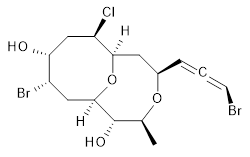
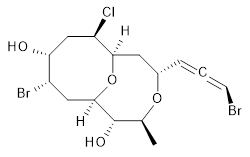
Here’s another interesting application of computed NMR spectra to resolve the structure of natural products. Braddock and Rzepa have examined obtusallenes V (1), VI (2) and VII (3).1 The geometries were optimized at mPW1PW91/6-31G(d,p) and the chemical shifts were obtained at this level and using the aug-cc-pVDZ basis set. The larger basis reduces the error and no statistical correction need be applied. The coordinates of these compounds are available through this web-enhanced object of the paper.


1


2


3

The confusion in these structures relates to the position of the halide attachments. For 1 and 2, the problem is which halide (Br or Cl) is at C-7 and C-13. The original structures proposed had these halogens switched from what I’ve drawn, and the correlation between the computed chemical shifts for these original structures and the experiment shows significant deviation: a mean deviation of 1.42 ppm for 1 and 1.67 ppm for 2. Using the structures shown above, along with switching the assigned 13C chemical shifts gives much better agreement between the computed and experimental values; the mean deviation is 1.15 ppm for both 1 and 2. Unfortunately the stereochemistry about the allene cannot be determined using NMR – the two different isomers have similar chemical shifts. Similarly, the structure of 3 is predicted as shown above, though the experiment reported only some of the chemical shifts so some uncertainty remains.

References

(1) Braddock, D. C.; Rzepa, H. S., "Structural Reassignment of Obtusallenes V, VI, and VII by GIAO-Based Density Functional Prediction," J. Nat. Prod., 2008, DOI: 10.1021/np0705918.

InChIs

1: InChI=1/C15H18Br3ClO3/c1-8-14(18)12-6-13(17)15(22-12)7-10(19)11(21-15)5-9(20-8)3-2-4-16/h3-4,8-14H,5-7H2,1H3/t2-,8-,9+,10+,11-,12+,13-,14-,15-/m0/s1
InChIKey = PVIUYMGCQVXTIT-JUHTWQEGBT

2: InChI=1/C15H19Br2ClO3/c1-9-14(17)12-4-5-15(20-12)8-11(18)13(21-15)7-10(19-9)3-2-6-16/h3,6,9-14H,4-5,7-8H2,1H3/t2-,9-,10+,11+,12+,13-,14-,15-/m0/s1
InChIKey = WPEZFVRVOYPLJW-LXJGPXSEBA

3: InChI=1/C15H20Br3ClO3/c1-8-15(18)14-6-10(17)13(22-14)7-11(19)12(20)5-9(21-8)3-2-4-16/h3-4,8-15,20H,5-7H2,1H3/t2-,8-,9+,10-,11+,12-,13-,14+,15-/m0/s1
InChIKey = QTZNVLUNNGQAFG-SOAHCKLOBC

NMR Steven Bachrach 24 Mar 2008 1 Comment

NICS Scan

Professor Amnon Stanger sent me an email with a couple of comments concerning points made in my book. I take up the first of his comments here. Stanger has pointed me to what looks to be the true first study evaluating NICS on a grid of points, done by Klod and Kleinpeter in 2001.1 They computed NICS values on a 3-D grid and then created iso-chemical-shielding surfaces to pictorially represent the shielding and deshielding zones (or cones) created by π-bonds (like ethane and ethyne) and aromatic compounds. In a similar vein, Lazzeretti2 evaluated the out-of-plane component of the magnetic shielding tensor (σ||) on a 2-D grid to demonstrate the shielding and deshielding zones of π-systems, particularly aromatic systems. These plots clearly demonstrate the “cones” one typically finds in introductory organic texts to explain NMR effects.

(1) Klod, S.; Kleinpeter, E., “Ab Initio Calculation of the Anisotropy Effect of Multiple Bonds and the Ring Current Effect of Arenes—Application in Conformational and Configurational Analysis,” Chem. Soc., Perkin Trans. 2, 2001, 1893-1898, DOI: 0.1039/b009809o.

(1) Viglione, R. G.; Zanasi, R.; Lazzeretti, P., “Are Ring Currents Still Useful to Rationalize the Benzene Proton Magnetic Shielding?,” Org. Lett., 2004, 6, 2265-2267, DOI: 10.1021/ol049200w.

NMR Steven Bachrach 27 Nov 2007 No Comments

Next Page »