Archive for the 'Uncategorized' Category

Helium Bonds

Rzepa has published a theoretical study of potential stable molecules containing a bond to helium.1 The work was inspired by the post on this blog pertaining to potential hypervalent carbon species that mimic the SN2 transition state. Rzepa first reported some of his results on his own blog (see this post and previous ones). The upshot is that structures like 1 appear to possess real bonds to helium!


1

As always, Henry has deposited his structures (see here) and so I have not reproduced any structures.

As an aside I am greatly inspired by this paper as offering an example of how non-traditional media – our two blogs – led to new science, and one that was published by a very forward-thinking publisher (Nature), who recognizes the value of new technologies that facilitate (and not degrade nor supplant) the traditional scientific communication media.

References

1) Rzepa, H. S., “The rational design of helium bonds,” Nature Chem., 2010, 2, 390-393, DOI:10.1038/nchem.596.

Uncategorized Steven Bachrach 22 Jun 2010 2 Comments

A Protobranching model?

Kemnitz and co-workers have added to the protobranching debate (see these earlier posts i, ii, iii) with a proposal for how branching can be stabilizing.1 A normal chemical bond can be described within the valence bond prescription as an interplay of three different contributors: a covalent term (a) and two ionic terms (b and c). For a typical covalent bond, term a dominates, and for the recently proposed “charge-shift” bond (see this post), the ionic VB terms dominate.

Kemnitz now examines propane using a valence bond method and finds the following. The dominant VB term is the standard, two-covalent bond structure I. Next in importance are the single bond ionic VB structures II. Lastly, the 1,3-ionic structures III contribute about 9% to the total VB wavefunction. These contributions are only possible with branching and provide a net stabilization of about 1.6 kcal mol-1. This energy is nearly identical to the stabilization energy associated with the protobranching concept proposed by Schleyer, Houk and Mo. This type of ionic structure just might be the mechanism for protobranching stabilization.

References

(1) Kemnitz, C. R.; Mackey, J. L.; Loewen, M. J.; Hargrove, J. L.; Lewis, J. L.; Hawkins, W.
E.; Nielsen, A. F., "Origin of Stability in Branched Alkanes," Chem. Eur. J. 2010, 16,6942-6949, DOI: 10.1002/chem.200902550

Uncategorized Steven Bachrach 15 Jun 2010 No Comments

Protobranching once again!

An interesting little discussion on the meaning of “protobranching” appears in a comment1 and reply2 in J. Phys. Chem. A. Fishtik1 calls out the concept of protobranching on three counts:

  1. It is inconsistent to count a single protobranch for propane, but then not have three protobranches in cyclopropane
  2. It is inappropriate to utilize methane as a reference species.
  3. Group additivities work well.

I tend to side more with Schleyer2 in his rebuttal of these charges, and so will present from this perspective. First off, Schleyer argues that he can define protobranch anyway he wants! (He in fact cites a quote of Humpty Dumpty from Lewis Carroll to support this stance!) Schleyer is of course correct. Fishtik should really have argued “Does Schleyer’s definition of protobranch add to our understanding of strain?” So Fishtik claims that there is an internal inconsistency in Schleyer’s definition – taking the view point that the C-(C)2(H)2 group is identical to the protobranch. Schleyer counters that no, the protobranch is this group along with the caveat that the two terminal carbons are not connected, like they are in cyclopropane. I really prefer Gronert’s approach here – where he argues for just what are the implications of Schleyer’s definition (see this post).

Fishtik refuses to use methane as a reference since it is a unique molecule. Again, if one takes the group-centric view, then methane possesses a group that no other compound has. But Schleyer counters that one is free to choose whatever reference one thinks is appropriate, just be sure to understand what properties are conserved or not conserved when using that reference selection. To me, this is really the key for the entire discussion: choose one’s references in such a way as to minimize differences between your reference compound(s) and the molecule(s) you are trying to explore to just the property of interest. So, if one is interested in quantifying ring strain, the reference compounds should be not only be strain-free but they should differ in no other way from the cyclic molecule other than the presence of the ring! Unfortunately, there is no unique or non-arbitrary way to do this! Schleyer’s approach and Fishtik’s approach differ in just what properties they believe are important to conserve and which properties they are going to lump into the concept “ring strain”.

Fishtik shows a whole slew of reactions that demonstrate the consistency of group additivity methods. Schleyer correctly points out that these examples are really intimately related and represent only one type of definition. Again, there is really no unique set of references, and many, many different models have been developed, all of which can match experimental data quite well – like for example heats of formation. The key is what these models say in terms of interpreting, say, these heats of formation. Can one rationalize trends and make predictions with the model? If so, then it has utility. If not, then the model should be discarded. Ultimately, Fishtik’s argument is that the protobranching model does not assist us in understanding strain – Schleyer would obviously beg to differ!

References

(1) Fishtik, I., "Comment on "The Concept of Protobranching and Its Many Paradigm Shifting Implications for Energy Evaluations"," J. Phys. Chem. A, 2010, ASAP, DOI: 10.1021/jp908894q

(2) Schleyer, P. v. R.; McKee, W. C., "Reply to the "Comment on ‘The Concept of Protobranching and Its Many Paradigm Shifting Implications for Energy Evaluations’"," J. Phys. Chem. A, 2010, ASAP, DOI: 10.1021/jp909910f

Uncategorized Steven Bachrach 13 Apr 2010 2 Comments

From ACS San Francisco – part II

So yesterday mornings “Future of Scholarly Publishing” was quite interesting. Steve Heller gave his usual enjoyable presentation of InChI and the InChI Trust. The establishment of the Trust ensures that progress and technical support for InChI continues on.

Alex Wade from Microsoft gave a great overview of the activities Microsoft has ongoing in the area of scholarly communication. I was impressed if not even overwhelmed with all that Microsoft is doing. If you were worried about Microsoft taking over the world, then this talk will only reinforce that concern! I will post a link to his talk once it is made available. UPDATE: Here is Alex’s PowerPoint presentation.

Next was Peter Murray-Rust, and this was a typical Peter talk. He started off by truly going after all scientific publishers for restrictions to and copyright notices plastered all over supplementary materials. These materials are almost exclusively data, and data cannot be copyrighted. Peter pleaded with publishers to allow free and unrestricted access to these materials and I wholeheartedly second this! Peter then demonstrated a number of chemistry semantic tools. His talk will be posted online, and I’ll get the URL here when it’s available.

The last of the talks I was able to see before leaving for the airport was by Joe Townsend. He demonstrated the new Chem4Word plugin (now rebranded “Chemistry Add-in for Word”). This tool allows for chemistry semantics to be placed into a docx file, with all chemistry preserved as xml. This is an amazing first step towards providing authors the proper tools to create data- and chemistry-rich documents that preserve chemical knowledge for distribution and archiving. The plugin is available here, and is only applicable for Word 2007, and that poses an interesting problem as pointed out during the Q&A session – ACS pubs cannot accept docx files, so all that semantics will be lost. As was mentioned in the talk, that’s data destruction, and it’s time for authors and readers to demand better from the STM publishers!

Uncategorized Steven Bachrach 25 Mar 2010 2 Comments

From ACS San Francisco

Not particularly strong programming at the year’s spring ACS meeting – but one great session in the organic division yesterday. This was the awards session in honor of John Baldwin getting the James Flack Norris Award for physical organic chemistry.

First to speak was James Duncan, who discussed his recent CASSCF computations looking for pseudopericylic [3,3]-sigmatropic migrations. I will be commenting on his latest work in a post that will appear soon.

I had to skip the next talk, but came back to hear John Brauman discuss recent work on the solvation effect in the SN2 reaction. This is an interesting case of where the screening of larger substituents is counterbalanced by geometric changes that lead to greater charge distribution. The net effect is that they cancel each other out, and the methyl,ethyl, iso-propyl, butyl β-effect is negligible.

Next was Peter Schreiner who discussed his carbene work, specifically the enormous tunneling effect observed in hydroxymethylene (see this post). He discussed some new work, that is if anything even more fantastic on methylhydroxycarbene – look for this work perhaps later in 2011.

Last to speak was John Baldwin – and he described his truly tour de force efforts in examining the [1,3]-rearrangements of vinylcyclopropane and vinylcyclobutane. The former work is described in my book, while the later study is still ongoing.

John’s work is amazingly painstaking and careful. I am truly in awe of his dedication in taking on extremely difficult studies that require enormous care. John has really taught us a lot – not just about these rearrangements (they involve diradicals on a flat plateau demanding dynamic analysis – but how to think about a study and then carry it out to fruition so that all details are assessed. A truly deserving recipient!

Uncategorized Steven Bachrach 23 Mar 2010 No Comments

Conformational preference in vinyl sulfoxides

The conformational preference of α-β-unsaturated carbonyl compounds is well established: the two π-bonds prefer to be in conjugation with the oxygen and three carbon atoms (nearly) coplanar. Now, what about the conformational preference of vinyl sulfoxides? Since the S-O π-bond is weak, alternate conformations might be favorable. Podlech has prepared some 1,3-dithian-1-oxides that should be conformationally static and thereby offer some insight into this question.1 The dithiane oxides 1 and 2 can exist with the S-O bond in the axial (a) or equatorial (e) positions.


1a: R=H
2a: R=Me


1e: R=H
2e: R=Me

The B3LYP/6-31++G(d,p) geometries are shown in Figure 1. The equatorial structure has the two π bonds close to coplanar (the C-C-S-O dihedral is 14°), while in the axial isomers, the C-C-S-O dihedral is about -122°.

1a

1e

2a

2e

Figure 1. B3LYP/6-31++G(d,p) optimized structures of 1 and 2.

Podlech argues for a πC=C → σ*S-O stabilization in the axial isomer on the basis of two observations. First, the UV maximum absorbance in 1a is at 266nm, 12 nm greater than in 1e and similarly, the UV maximum in 2a is 2 nm higher than in 2e. Second, NBO analysis indicates a much larger contribution for this interaction in 1a (3.05 kcal mol-1) than in 1e (0.07 kcal mol-1).

However, I am unconvinced that this interaction is really dominant. Oxidation of the precursor dithiane with MCPBA gives a 42:58 ratio of 1e:1a and a 76:24 ratio of 2e:2a, which indicates a preference for the equatorial form of 1 and only a small preference for the axial form of 2. Unreported by Podlech (even in the supporting materials) is the relative computed energy difference of the two stereoisomers. At B3LYP/6-31++G(d,p) with ZPE, 1e is 2.6 kcal mol-1 lower in energy than 1a and 2e is 0.05 kcal mol-1 lower than 2a. So, in the gas-phase, it appears that the vinyl sulfoxides prefer the equatorial orientation, just as in α-β-unsaturated carbonyl compounds. The πC=C → σ*S-O interaction is stronger in the axial conformation, but it is doubtful that this alone manifests in any diastereomeric selectivity.

References

(1) Ulshöfer, R.; Podlech, J., "Stereoelectronic Effects in Vinyl Sulfoxides," J. Am. Chem. Soc. 2009, 131, 16618-16619, DOI: 10.1021/ja904354g

Uncategorized Steven Bachrach 25 Jan 2010 3 Comments

Atomic couterpoise correction for BSSE

Hard to believe but here’s another approach to dealing with intramolecular basis set super position error (BSSE). (I blogged on a previous approach here.) Jensen’s approach1 is to define the atomic counterpoise correction as

ΔEACP = Σ EA(basisSetA) – EA(basisSetAS)

where this sum runs over all atoms in the molecule and EA(basisSetA) is the energy of atom A using the basis set centered on atom A. The key definition is of the last term EA(basisSetAS), where this is the energy of atom A using the basis set consisting of those function centered on atom A and some subset of the basis functions centered on the other atoms in the molecule. The key assumption then is just how to select the subset of ghost functions to include in the calculation of the second term.

For intermolecular basis set superposition error, Jensen suggests using the orbitals on atom A along with all orbitals on the other fragment, but not include the orbitals on other atoms in the same fragment where atom A resides. He demonstrates that this approach gives essentially identical superposition corrections as the traditional counterpoise correction for N2, ethylene dimer and benzene dimer.

For intramolecular corrections, Jensen suggests keeping only the orbitals on atoms a certain bonded distance away from atom A. So for example, ACP(4) would indicate that the energy correction is made using all orbitals on atoms that are 4 or more bonds away from atom A. Jensen suggests in addition that orbitals on atoms that are farther than some cut-off distance away from atom A may also be omitted. He demonstrates the use of these ideas for the relative energies of tripeptide conformational energies.

So while the ACP method is conceptually simple, and also computationally efficient, it does require some playing around with the assumptions of which orbitals will comprise the appropriate subset. And it may be that one has to tune this selection for the individual system of interest.

References

(1) Jensen, F., "An Atomic Counterpoise Method for Estimating Inter- and Intramolecular Basis Set Superposition Errors," J. Chem. Theory Comput. 2010, 6, 100–106, DOI: 10.1021/ct900436f.

Uncategorized Steven Bachrach 13 Jan 2010 No Comments

Why blog?

I have recently finished reading Free: The Future of a Radical Price by Chris Anderson (buy it here). The premise of the book is that giving things away is not only a serious business plan, it might just be the only business plan for the new economy. I found the book interesting, but ultimately disappointing. All of the models that are in practice or ones he proposes rest upon analogy to the old Gillette razor blade model: give away the razor and sell the blades. The perhaps most successful modern example is giving away search services and browsers and email services all supported by ad placement (Google). Perhaps less successful universally, but certainly working for some, are those bands who give away songs and albums, hoping it leads to concert visits where fans will not just buy tickets but also t-shirts and other paraphernalia.

Giving away stuff is a nice idea, and in the field of science, particularly computational science, we have lots of examples, like free operating systems, free technical software, and free databases. But in reality they’re not truly free.

The problem ultimately is that money needs to be made somewhere; people got to eat and put a roof over their heads and get clothes and that requires real cash. So virtually all of the people developing the computational tools are being paid in some other way – say off of an NSF grant, or by the university or by their commercial employer. Or one produces some code in the hope that it attracts attention that can lead to real paying employment; one might think of this as “reputation payment” that might sometime soon be cashed in for real currency!

Now some stuff, and that can include valuable stuff, is produced truly for free. A great example are the thousands of people who contribute to Wikipedia in their free time. Those chemists who have volunteered to clean up wikipedia entries have done a great job (like this one on the recently infamous PETN) and they not only don’t get paid, they largely contribute anonymously – so they don’t even get a “reputation payment”. The same goes for the many contributors to ChemSpider. But this work is done piecemeal and infrequently and must by definition be a personal low priority because of the need to do work that puts cash in hand.

So, that leads me to ask the question “why Blog? especially why blog in chemistry?” Not an easy one to really figure out, because unless one is just doing it on a lark or very infrequently, the time necessary to blog in a serious way is quite an investment. One has to figure out how to make the blog pay off in some way. Given that our community has not adopted blogging as a means for publishing original research, though Henry Rzepa is attempting to push on this course of action (see his blog), blogging must serve some other purpose, and one that can either directly pay cash or directly raise one’s reputation.

So I’ll answer the question for myself. I blog not for altruistic reasons. While I hope that the blog provides solid information and leads people to interesting articles, that’s not why I do it. Rather the blog serves to meet two goals, both directly related to potential cash. First, the blog is an ongoing update of my monograph Computational Organic Chemistry and so the blog serves as both a way to make the book more valuable to its owners and as a great advertisement for the book – hopefully leading to continuing new sales (like right here!). Second, the systematic blogging builds up materials for a new edition of the book that I hope to begin serious work on in 2011. These blog posts will certainly help reduce the time I anticipate needing to invest in the revisions. I hope the next edition can be as successful as the first has been so far.

So, I’d really like to encourage more people to be creative about making chemical blogs viable. I enjoy many of my colleagues’ blogs, and I wish they would blog more often and that others would also step into the breach. I moved the blog and the book website off of the university campus not just to take advantage of the services that the web host provides (like back-up and 24/7 availability, etc.), but to allow for the possibility of making the sites more commercial – like by including fixed ads or Google ads. I haven’t done this because the blog is really self-sustaining right now, but this route might be a way for more people to think about starting their own blogs.

And I’d like to see more serious scientific blogging that acts to push the boundaries of how we can use this technology to enhance our scientific communication. Remember, we are the chemistry community and if enough of us make this technology our own, others will have to take it seriously and adopt new communication modes. Otherwise, we are stuck kowtowing to the whims and fears of publishers and scientists afraid of the new.

Uncategorized Steven Bachrach 11 Jan 2010 7 Comments

Oxyallyl diradical

The longstanding unknown oxyallyl diradical (1) singlet-triplet gap has now been addressed with a very nice photoelectron spectroscopy study by Lineberger with interpretation greatly aided by computations provided by Hrovat and Borden.1

The photoelectron detachment spectrum of oxyallyl radical anion shows 5 major peaks, one at 1.942 eV and a series of four peaks starting at 1.997 eV separated by 405 cm-1.

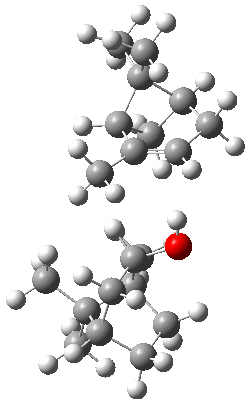
B3LYP/6-311++G(d,p) computations indicate that the energy for electron detachment from the radical anion to triplet oxyallyl diradical is 1.979 eV. (The structure of triplet 1 is shown in Figure 1.) Further, the computed vibrational frequency of the C-C-C bend is 408 cm-1. These computations suggest that the four peak sequence represents a vibrational progression in the C-C-C bend of the triplet oxyallyl diradical.

1A1

3B2

Figure 1. Structures of the singlet and triplet oxyallyl diradical 1.1

CASPT2 computations on singlet oxyallayl diradical indicate that it lies in a very shallow well, lower than the zero-point energy. (This structure is shown in Figure 1.) In fact, the singlet diradical can collapse without a barrier to cyclopropanone. Interestingly, the C-O stretching frequency of 1 is computed to be 1731 cm-1, and close inspection of the photoelectron spectrum does show a progression of this magnitude originating from peak A. Therefore, both the singlet and triplet states of 1 are identified and their gap is extraordinarily small – the singlet is only 0.055 eV lower in energy than the triplet.

References

(1) Ichino, T.; Villano, S. M.; Gianola, A. J.; Goebbert, D. J.; Velarde, L.; Sanov, A.; Blanksby, S. J.; Zhou, X.; Hrovat, D. A.; Borden, W. T.; Lineberger, W. C., "The Lowest Singlet and Triplet States of the Oxyallyl Diradical," Angew. Chem. Int. Ed., 2009, 48, 8509-8511, DOI: 10.1002/anie.200904417

Uncategorized Steven Bachrach 07 Dec 2009 No Comments

Commentary on the nature of bonding

Though not quite germane to this blog (Computational Organic Chemistry), the recent commentary by Rzepa1 does deserve mention. Henry takes on, in a nice breezy style (note the title: The importance of being bonded), the nature of bonding in 1, which initially was thought to be of structure 1a but subsequent x-ray structural analysis suggested the presence of an S-S bond, i.e. 1b. Schleyer has applied NICS analysis to suggest that the compound is bishomoaromatic.2 Henry utilizes AIM and ELF analysis to discuss the nature of the bonding, including the possibility of HH interaction between the methyl groups and trishomoaromatic character. What I liked about the article is that Henry rightly makes the case that exploration of the notion of “bonding” can be quite opaque and often leads to stretching the models we commonly employ. Well worth the read!

References

(1) Rzepa, H. S., "The importance of being bonded," Nat. Chem., 2009, 1, 510-512, DOI: 10.1038/nchem.373.

(2) Zhang, Q.; Yue, S.; Lu, X.; Chen, Z.; Huang, R.; Zheng, L.; Schleyer, P. v. R., "Homoconjugation/Homoaromaticity in Main Group Inorganic Molecules," J. Am. Chem. Soc., 2009, 131, 9789-9799, DOI: 10.1021/ja9029285

Uncategorized Steven Bachrach 10 Nov 2009 5 Comments

Next Page »