Optical activity of a chiral calix[4]arene

Optical Rotation & calixarenes Steven Bachrach 01 Sep 2010 No Comments

Determination of absolute configuration remains a difficult undertaking, one usually solved by x-ray crystallography. In my book (Chapter 1.6.3) and blog (see these posts) I have noted the use of computations in conjunction with optical rotation or electronic circular dichroism as an alternative: possible configurations are optimized and their optical properties are computed and then matched against experimental spectra.

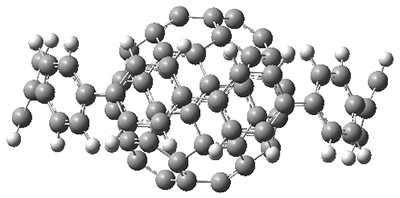
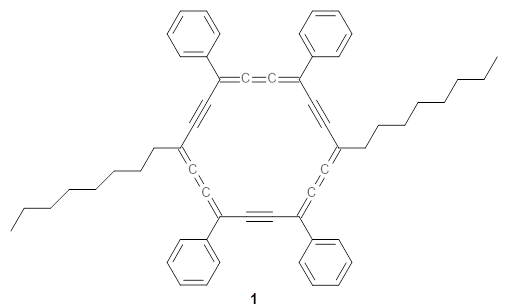
Neri and coworkers have utilized this approach to determine the absolute configuration of the chiral calix[4]arene 1.1

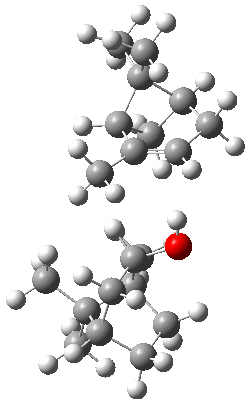
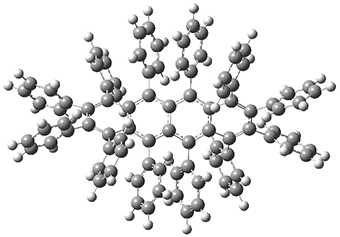
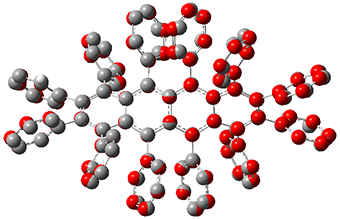
Computed optical rotations (TDDFT/B3LYP/6-31G* at 5 frequencies) are compared with experimental values in Table 1. While the magnitude is off (as is typical) the sign of the activity along with the trend matches up very well for the cS configuration shown in Figure 1. It should be noted that a second conformation makes up about 10% of the Boltzmann population, and the contribution of this second configuration is included in the computed values shown in Table 1. In addition, computations at higher levels give very similar results. Lastly, the computed ECD spectrum of the cS isomer also matches up well with experiment.

Table 1. Optical rotation of the cS isomer of 1 compared with experiment

Wavelength (nm)

Experiment

Computed

589.3

108

58.8

577

120

61.7

546

140

70.2

435

264

122.6

405

367

147.6

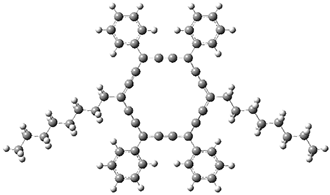
Figure 1. B3LYP/6-31G* optimized structure of the major conformation of 1.

Given the relatively low level of theory employed here, further use of this combined experimental/computational approach to obtaining absolute configurations of large molecules is encouraged.

References

(1) Talotta, C.; Gaeta, C.; Troisi, F.; Monaco, G.; Zanasi, R.; Mazzeo, G.; Rosini, C.; Neri, P., "Absolute Configuration Assignment of Inherently Chiral Calix[4]arenes using DFT Calculations of Chiroptical Properties," Org. Lett., 2010, 12, 2912-2915, DOI: 10.1021/ol101098x

InChIs

1: InChI=1/C59H78O7/c1-16-19-64-53-36-22-35-32-47(59(13,14)15)50(51-48(61)33-45(60)34-49(51)62)46(52(35)63)31-41-30-44(58(10,11)12)29-40(55(41)66-21-18-3)24-39-28-43(57(7,8)9)27-38(54(39)65-20-17-2)23-37(53)26-42(25-36)56(4,5)6/h25-30,32-34,60-63H,16-24,31H2,1-15H3
InChIKey=VGWOVZXMYMCPQO-UHFFFAOYAS

Cyclobutenone as a dienophile

Diels-Alder Steven Bachrach 24 Aug 2010 3 Comments

Li and Danishefsky report a study of the Diels-Alder reaction involving cyclobutenone 1 as the dienophile.1 They claim that “perhaps the ring strain of 1 might well serve to enhance its dienophilicity relative to corresponding cyclopentenones or cyclohexenones.” In fact, 1 is an excellent dienophile, with reactions at or below 0° being accomplished in less than half a day with yields upwards of 90%. The reaction goes with endo selectivity.

What is surprising to me is the statement in the article:

While the magnitude of the effect could not have been predicted in advance, the rate enhancement with 1 must reflect the favorable effects of rehybridization of two particularly strained sp2 carbons in the cycloaddition transition state.

Now, Danishefsky alludes to upcoming computations results in a future paper, but I don’t see why the rate enhancement could not have been “predicted in advance”. So, I have optimized the structures of reactants, endo and exo transition states, and products of the reaction of 1,3-butadiene with 1, cyclopentenone 2 and cyclohexenone 3 at B3LYP/6-311G(d) – Reactions 1-3.

The endo TS is preferred for the reaction of 1 and 2, while the endo and exo TSs for 3 are essentially isoenergetic. The optimized geometries are shown in Figure 1.

1TSendo

2TSendo

3TSendo

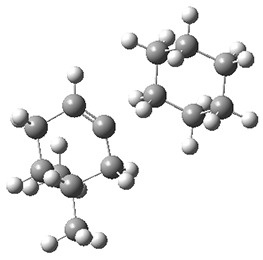
Figure 1. B3LYP/6-311G(d) optimized geometries of the endo TSs of Reactions 1-3.

The computed activation barriers and overall reaction energies are listed in Table 1. Clearly, the cycloaddition of 1 is favored both in terms of kinetics (having the lowest barrier) and thermodynamically (having the most exothermic reaction energy). In fact, the reaction barriers increases in going from 1 to 2 to 3 and the exothermicity decreases in that same order. This nicely dovetails with the strain energies of the dienophiles and the fact that cyclopententones and cyclohexenones are generally poor dienophiles. Thus, one clearly could have predicted these results in advance!

Table 1. Activation and Reaction Energy (kcal mol-1) for Reactions 1-3.

Reaction

Ea

ΔE

1

18.8

-35.2

2

24.1

-27.1

3

25.7

-27.1

Nonetheless, the experimental work is extremely nice and this work offers a new avenue into some interesting bicyclic structures.

Note: This post has been modified to correct the errors in the product structures and their associated InChIs and InChIKeys.

References

(1) Li, X.; Danishefsky, S. J., "Cyclobutenone as a Highly Reactive Dienophile: Expanding Upon Diels-Alder Paradigms," J. Am. Chem. Soc., 2010, 132, 11004-11005, DOI: 10.1021/ja1056888

InChIs

1: InChI=1/C4H4O/c5-4-2-1-3-4/h1-2H,3H2
InChIKey=DFLRGCFWSRELEL-UHFFFAOYAP

1prod: InChI=1/C8H10O/c9-8-5-6-3-1-2-4-7(6)8/h1-2,6-7H,3-5H2/t6-,7-/m0/s1
InChIKey=AYXQRXAAJYZWJJ-BQBZGAKWBC

2: InChI=1/C5H6O/c6-5-3-1-2-4-5/h1,3H,2,4H2
InChIKey=BZKFMUIJRXWWQK-UHFFFAOYAH

2prod: InChI=1/C9H12O/c10-9-6-5-7-3-1-2-4-8(7)9/h1-2,7-8H,3-6H2/t7-,8-/m0/s1
InChIKey=LOJATDUUSCWAOA-YUMQZZPRBU

3: InChI=1/C6H8O/c7-6-4-2-1-3-5-6/h2,4H,1,3,5H2
InChIKey=FWFSEYBSWVRWGL-UHFFFAOYAT

3prod: InChI=1/C10H14O/c11-10-7-3-5-8-4-1-2-6-9(8)10/h1-2,8-9H,3-7H2/t8-,9-/m0/s1
InChIKey=LFDGSLNQYSSFGI-IUCAKERBBQ

Acidity of remote protons

Acidity & Kass Steven Bachrach 17 Aug 2010 1 Comment

The α-proton of ketones and aldehydes are acidic, thanks to delocalization of the resulting anion. However, α-protons at a bridgehead position are much less acidic – the resulting anion is not delocalized as the enolate would be an anti-Bredt alkene. So, what about more remote protons from the carbonyl – would they exhibit enhanced acidity due to inductive or field effects?

Kass has examined the deprotonation of 2-adamantone 1 via experiment and computation.1 The relative energies of the five different anions are listed in Table 1. Previous H/D exchange experiments indicate that the relative reactivity is βax > βeq > α, and this is well reproduced by computations.2

Table 1. Relative energies (kcal mol-1) of the enolates of 1.


compound

M06-2x/aug-cc-pVDZ

G3


α

4.27

5.60

βax

0.0

0.0

βeq

4.46


γ

2.28

3.40

δ

6.17

7.55

2

-1.58

0.56


Kass’ bracketing experiments indicate the enthalpy for deptrotonation of 2-adamantone is 394.7 ± 1.4 kcal mol-1. This is in nice accord with the computational results for loss of the βax proton: 393.8 (M06-2x/aug-cc-pVDZ) and 396.8 kcla mol-1 (G3). One interesting computational result is a competive cyclic structure 2, whose stability is similar to that to the βax ion at M06-2x and is the optimized structure produced at MP2/6-31G(d) when searching for the βeq enolate.

So, to answer our question, protons remote from a carbonyl are more acidic than alkane
analogues, but much less acidic than typical α-protons of ketones.

References

(1) Meyer, M. M.; Kass, S. R., "Enolates in 3-D: An Experimental and Computational Study of Deprotonated 2-Adamantanone," J. Org. Chem., 2010, 75, 4274-4279, DOI: 10.1021/jo100953y

(2) Stothers, J. B.; Tan, C. T., "Adamantanone: stereochemistry of its homoenolization as shown by 2H nuclear magnetic resonance," J. Chem. Soc., Chem. Commun., 1974, 738-739, DOI: 10.1039/C39740000738

InChI

1: InChI=1/C10H14O/c11-10-8-2-6-1-7(4-8)5-9(10)3-6/h6-9H,1-5H2
InChIKey=IYKFYARMMIESOX-UHFFFAOYAE

2: InChI=1/C10H13O/c11-10-7-2-5-1-6(4-7)9(10)8(10)3-5/h5-9H,1-4H2/q-1
InChIKey=WTXOXRNASCZDME-UHFFFAOYAE

Shannon Aromaticity

Aromaticity Steven Bachrach 11 Aug 2010 1 Comment

I recently finished reading a book on the application of information theory to “reality”: Decoding Reality by Vlatko Vedral. It’s for the layman (me!) and I was wondering what applications have information theory made in chemistry. Well, just by accident I happened upon a paper by Noorizadeh which proposes an information-based metric to evaluate aromaticity!1 (I know what you’re thinking – we need another aromaticity metric like we need another hole in the head.) I don’t want to suggest that this metric, which he calls “Shannon aromaticity” after the inventor of information theory, will substitute for previous ones (like aromatic stabilization energy or NICS). But the application here is interesting.

Shannon defined entropy in the information sense as

S(r) = -Σ pi ln pi

Where pi is the probability of occurrence i. This can be converted into a quantum analogue as

S[ρ] = -∫ρ(r)  ln ρ(r) dr.

Noorizadeh suggests evaluating the electron density at the bond critical points of an aromatic ring and then summing the values of S at each of these ring critical points. An ideal aromatic ring would have Smax= ln (N) where N is the number of bonds in the ring. So, the Shannon aromaticity (SA) is then defined as the difference between the maximum value (ln (N)) and the sum over the ring critical points. A small value would indicate an aromatic ring, and a large value would indicate an antiaromatic ring.

The paper shows a strong correlation exists between the new SA metric and the warhorses ASE and NICS and HOMA for a variety of aromatic, antiaromatic and non-aromatic systems. This new metric is easy to compute and perhaps offers a new way to be thinking about a very old concept: aromaticity.

References

(1) Noorizadeh, S.; Shakerzadeh, E., "Shannon entropy as a new measure of aromaticity, Shannon aromaticity," Phys. Chem. Chem. Phys., 2010, 12, 4742-4749, DOI: 10.1039/b916509f.

Thorpe-Ingold Effect

Jorgensen & Solvation Steven Bachrach 27 Jul 2010 2 Comments

Often gem-dialkyl substitution accelerates a reaction, for example in the formation of an epoxide via reaction 1. Here the relative rates are 1:21:252 in going from 1 to 2 to 3.1 This acceleration is the Thorpe-Ingold effect and had been suggested to arise from a steric reaction: that the methyl groups contract the angle and bring the terminal groups closer together.


1: R1 = R2 = H
2: R1 = Me, R2 = H
3: R1 = R2 = Me

Kostal and Jorgensen2 have examined the reaction of the 2-chloroethoxides 1-3 using computations, especially to look at the effect of solvent. At MP2/6-311+G(d,p) and CBS-Q, the relative rates (based on the activation free energy ΔG) are 1:2.8:17 and 1:0.7:3.7, respectively. Evidently there is no significant rate enhancement afforded by gem-substitution in the gas phase.

However, solution computations give a very different result. Using PCM along with the MP2 method, the computed relative rates are 1:5.8:1100 and with the Monte Carlo-Free Energy Perturbation method, the relative rates for aqueous solution are 1:30:773. Thus, the Thorpe-Ingold acceleration is due to solvent. Analysis of the hydrogen bonded structures and the solute-water pair distributions suggest that increasing alkyl substitution reduces the strength of solvation of the reactant, leading to the lower activation barrier.

References

(1) Jung, M. E.; Piizzi, G., "gem-Disubstituent Effect:Theoretical Basis and Synthetic Applications," Chem. Rev., 2005, 105, 1735-1766, DOI: 10.1021/cr940337h

(2) Kostal, J.; Jorgensen, W. L., "Thorpe-Ingold Acceleration of Oxirane Formation Is Mostly a Solvent Effect," J. Am. Chem. Soc., 2010, 132, 8766-8773, DOI: 10.1021/ja1023755

[6+4] and [4+2] cycloadditions: Unusual potential energy surfaces

Dynamics & cycloadditions Steven Bachrach 20 Jul 2010 1 Comment

Alder and co-workers have published a substantial theoretical study of potential [6+4]-cycloaddition reactions.1 There is much too much to summarize from this study, but I highlight here an interesting result that is consistent with one of the themes of the book and blog: unusual potential energy surfaces.

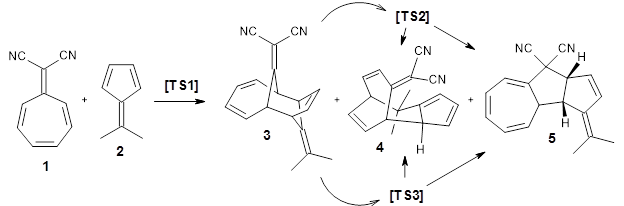
They examined two [6+4]-cycloadditon routes involving 1,3,5-hexatriene with 1,3-butadiene to give 1 and 2. These products are shown in Figure 1. A competing [4+2]-cycloaddition is also possible, giving rise to 3 and 4. Interestingly, only one TS is found leading to 1/3 and one TS leading to 2/4. (These TSs are also shown in Figure 1.) This is reminiscent of many examples from the book and blog where a single TS seems to lead to 2 different products. A valley-ridge inflection point divides the surface between 1 and 3 (VRI-1), and a second valley-ridge inflection point separates 2 from 4 (VRI-2). In addition a Cope transition state (CTS1) takes 1 into 3, and a second TS (CTS2) takes 2 into 4.

TS1

TS2

1

2

CTS1

CTS2

Figure 1. B3LYP/6-31G* optimized structures of the TSs and products of the reaction of 1,3,5-hexadiene with 1,3-butadiene.1

This type of surface requires study of the dynamics to truly predict what the outcome will be of the reaction. Unfortunately, the low barriers for the Cope rearrangements along with 3 and 4 being much more stable than 1 and 2 indicates that the [6+4] product is unlikely to be observed. Nonetheless, this is yet another example of an unexpected PES.

References

(1) Alder, R. W.; Harvey, J. N.; Lloyd-Jones, G. C.; Oliva, J. M., "Can π6 + π4 = 10? Exploring Cycloaddition Routes to Highly Unsaturated 10-Membered Rings," J. Am. Chem. Soc. 2010, 132, 8325-8337, DOI: 10.1021/ja1008135

InChIs

1: InChI=1/C10H14/c1-2-4-6-8-10-9-7-5-3-1/h1-4,9-10H,5-8H2/b3-1-,4-2+,10-9+
InChIKey=RBGHZLIWLPEVLM-OCXPBMDHBA

2: InChI=1/C10H14/c1-2-4-6-8-10-9-7-5-3-1/h1-4,9-10H,5-8H2/b3-1-,4-2-,10-9+
InChIKey=RBGHZLIWLPEVLM-ARMDLRMMBD

3: InChI=1/C10H14/c1-3-9-7-5-6-8-10(9)4-2/h3-5,7,9-10H,1-2,6,8H2/t9-,10-/m0/s1
InChIKey=ANOQDGNLTWJTRB-UWVGGRQHBI

4: InChI=1/C10H14/c1-3-9-7-5-6-8-10(9)4-2/h3-5,7,9-10H,1-2,6,8H2/t9-,10+/m1/s1
InChIKey=ANOQDGNLTWJTRB-ZJUUUORDBZ

Racemization of imidazolines

cycloadditions Steven Bachrach 13 Jul 2010 No Comments

Grinberg and colleagues have published a combination of VCD and computation to understand the racemization of imidazoline 1 when exposed to base.1 Experimental VCD performed at various temperatures indicates first-order kinetics with a barrier of about 24 kcal mol-1.

The mechanism for this racemization was proposed and supported with B3LYP/6-31G(d) computations. The anion of 1 can undergo a disrotatory ring opening to form 2, passing through TS1 with a barrier of about 21 kcal mol-1. Since 2 is chiral with the phenyl groups oriented in non-equivalent positions, ring closure of 2 will go back to 1 and not on to its racemate. In order to racemize, 2 must convert to 3, which can invert to 3’ and then on to 1’. While the barrier for ring opening is likely to be rate limiting, and it does match up reasonably well with the experimental value, the authors have not optimized the transition state that take 2 into 3 or the TS that interconverts 3 with 3’. It’s the former TS that may be pretty large as it requires disruption of the conjugation. Unfortunately, not only have the authors not computed these other TSs, the supplementary materials include only the optimized structure of 1 and not TS1, 2, or 3!

The authors do note that the ring opening is facilitated by the phenyl group on the chiral carbons of 1. They replaced the phenyls with cyclohexyl or cyclohexenyl groups and racemization is no longer observed. Strangely, the authors include in the supporting materials the optimized structures of these variants, but not the TSs for ring opening. Thus, the confirming evidence of a very high barrier for ring opening that would really nail down the mechanism is missing!

References

1) Ma, S.; Busacca, C. A.; Fandrick, K. R.; Bartholomeyzik, T.; Haddad, N.; Shen, S.; Lee, H.; Saha, A.; Yee, N.; Senanayake, C.; Grinberg, N., "Directly Probing the Racemization of Imidazolines by Vibrational Circular Dichroism: Kinetics and Mechanism," Org. Lett., 2010, 12, 2782–2785, DOI: 10.1021/ol100734t

InChIs

1: InChI=1/C21H18N2/c1-4-10-16(11-5-1)19-20(17-12-6-2-7-13-17)23-21(22-19)18-14-8-3-9-15-18/h1-15,19-20H,(H,22,23)/t19-,20-/m0/s1/f/h22H
InChIKey=UCCFUHZMGXEALP-RLNNBPQHDR

Understanding 1,3-dipole cycloaddition reactions

cycloadditions Steven Bachrach 06 Jul 2010 1 Comment

A couple of years ago Ess and Houk described computations on the cycloaddition reactions of ethene and ethyne with 9 different 1,3-dipoles 1-9.1,2 Two interesting results were noted: (a) though barrier heights systematically decreased with the decreasing HOMO-LUMO gap of the 1,3-dipole, the reaction barriers are the same for a given dipole with either ethane or ethyne; (b) The TS geometries about the ethane and ethyne fragments are similar, even though the reactions are quite different in overall reaction energies. This implies a violation of the Hammond Postulate.

Diazonium betaines

Nitrilium betaines

Azomethine betaines

Ess and Houk suggested that what dictated these reactions were the energies of distortion of the 1,3-dipole. This is the energy needed to distort the 1,3-dipole into its geometry in the TS. This is typically associated with the bending about the central atom, but rehybridization at the
terminal positions is also needed in many cases. A plot of the distortion energy against the activation barrier gives a line with an R2 value of 0.97.

Now Braida, Hiberty and coworkers have employed valence bond computations to interpret these findings.3 The 1,3-dipoles are composed of three valence bond structures a, b and c (shown for 1 below). The last structure (c) is the one associated with the cycloaddition reaction, as it is set up for making the two new bonds at the terminal positions.

The coefficients associated with these VB structures are given in Table 1. It is readily apparent that the degree of diradical character varies considerably among these compounds. Furthermore, for each set of 1,3-dipoles, increasing diradical content correlates with a decreased activation barrier. They also note a strong correlation of decreasing energy needed to excite the ground state 1,3-dipole to the diradical structure (of either the ground state geometry or in the TS geometry) with decreasing activation barrier. Thus, they conclude that it is the diradical character of the 1,3-dipole that controls the reaction – greater diradical character translates into a lower barrier. They argues that the concerted reaction proceeds in two phases, the first phase is distortion of the 1,3-dipole to create sufficient diradical character, and a second phase where the new bonds are made to the dipolarophile, independent of just what that dipolarophile happens to be.

Table 1. Coefficients of the 3 valence bond structures a-c for the ground state 1,3-dipoles 1-9.

1,3-dipole

a

b

c


1

0.55

0.24

0.22

2

0.43

0.32

0.25

3

0.32

0.41

0.28

4

0.58

0.21

0.21

5

0.38

0.36

0.26

6

0.26

0.48

0.26

7

0.48

0.18

0.34

8

0.38

0.24

0.38

9

0.29

0.29

0.41


References

(1) Ess, D. H.; Houk, K. N., "Distortion/Interaction Energy Control of 1,3-Dipolar
Cycloaddition Reactivity," J. Am. Chem. Soc., 2007, 129, 10646-10647, DOI: 10.1021/ja0734086

(2) Ess, D. H.; Houk, K. N., "Theory of 1,3-Dipolar Cycloadditions: Distortion/Interaction and Frontier Molecular Orbital Models," J. Am. Chem. Soc., 2008, 130, 10187-10198, DOI: 10.1021/ja800009z

(3) Braida, B.; Walter, C.; Engels, B.; Hiberty, P. C., "A Clear Correlation between the Diradical Character of 1,3-Dipoles and Their Reactivity toward Ethylene or Acetylene," J. Am. Chem. Soc., 2010, 132, 7631-7637, DOI: 10.1021/ja100512d

InChIs

1: InChI=1/N2O/c1-2-3
InChIKey=GQPLMRYTRLFLPF-UHFFFAOYAP

2: InChI=1/HN3/c1-3-2/h1H
InChIKey=JUINSXZKUKVTMD-UHFFFAOYAO

3: InChI=1/CH2N2/c1-3-2/h1H2
InChIKey=YXHKONLOYHBTNS-UHFFFAOYAZ

4: InChI=1/CHNO/c1-2-3/h1H
InChIKey=UXKUODQYLDZXDL-UHFFFAOYAL

5: InChI=1/CH2N2/c1-3-2/h1-2H
InChIKey=XILSUYCQFZFDIK-UHFFFAOYAR

6: InChI=1/C2H3N/c1-3-2/h1H,2H2
InChIKey=LSOWAYXKGAQDOG-UHFFFAOYAI

7: InChI<=1/CH3NO/c1-2-3/h2H,1H2
InChIKey=DITLKQKHWHCNBT-UHFFFAOYAB

8: InChI=1/CH4N2/c1-3-2/h2-3H,1H2
InChIKey=SSRHHPGUPLMOHA-UHFFFAOYAA

9: InChI=1/C2H5N/c1-3-2/h3H,1-2H2
InChIKey=DASBPRRGHQBNKH-UHFFFAOYAE

Distortional asymmetry leads to stereoinduction

stereoinduction Steven Bachrach 29 Jun 2010 3 Comments

What gives rise to the face selectivity in the epoxidation of the alkene of 1 and 2? And why is the epoxidation of 3 of opposite selectivity? Williams1 argues that the stereoinduction is due to distortional asymmetry, an argument similar to one made recently by Houk2,3 (see this post) and others for cycloaddition reactions.

The major conclusion from this paper is drawn from the potential energy curve that results from out-of-plane bending of the alkenyl hydrogens, as in Figure 1. The bending curves (computed at B3LYP/6-31g(2d,2p)//B3LYP/6-31+G(d))) are asymmetric: bending the hydrogens away from the three-member ring requires less energy than bending them towards the cyclopropyl ring. However, for 3, bending in the two directions is pretty similar, with a slight preference for bending towards the four-member ring.


Distortion angle (θ)

Fig. 1 Energy (kcal mol-1) vs distortion angle of alkenyl hydrogens

This type of bending is part of the distortions that have to occur to reach the transition state, and so Williams argues that the attack from the cyclopropyl face by the oxidant is preferred because of the easier geometric distortion of moving the hydrogen away. Williams makes standard orbital interaction arguments to rationalize the distortion preference.

References

(1) Kolakowski, R. V.; Williams, L. J., "Stereoinduction by distortional asymmetry," Nat. Chem. 2010, 2, 303-307, DOI: 10.1038/nchem.577.

(2)
Xu, L.; Doubleday, C. E.; Houk, K. N., "Dynamics of 1,3-Dipolar Cycloaddition Reactions of Diazonium Betaines to Acetylene and Ethylene: Bending Vibrations Facilitate Reaction," Angew. Chem. Int. Ed. 2009, 48, 2746-2748, DOI: 10.1002/anie.200805906

(3) Xu, L.; Doubleday, C. E.; Houk, K. N., "Dynamics of 1,3-Dipolar Cycloadditions: Energy Partitioning of Reactants and Quantitation of Synchronicity," J. Am. Chem. Soc., 2010, 132, 3029–3037, DOI: http://dx.doi.org/10.1021/ja909372f

InChIs

1: InChI=1/C9H12/c1-2-7-4-3-6(1)8-5-9(7)8/h1-2,6-9H,3-5H2
InChIKey=YNSKHNKUOPTLCL-UHFFFAOYAA

2: InChI=1/C10H11N/c11-5-8-9-6-1-2-7(4-3-6)10(8)9/h1-2,6-10H,3-4H2
InChIKey=XHTNELKCCFLXEU-UHFFFAOYAJ

3: InChI=1/C10H14/c1-2-8-4-3-7(1)9-5-6-10(8)9/h1-2,7-10H,3-6H2
InChIKey=OYPVZSANECKQOK-UHFFFAOYAR

Helium Bonds

Uncategorized Steven Bachrach 22 Jun 2010 2 Comments

Rzepa has published a theoretical study of potential stable molecules containing a bond to helium.1 The work was inspired by the post on this blog pertaining to potential hypervalent carbon species that mimic the SN2 transition state. Rzepa first reported some of his results on his own blog (see this post and previous ones). The upshot is that structures like 1 appear to possess real bonds to helium!


1

As always, Henry has deposited his structures (see here) and so I have not reproduced any structures.

As an aside I am greatly inspired by this paper as offering an example of how non-traditional media – our two blogs – led to new science, and one that was published by a very forward-thinking publisher (Nature), who recognizes the value of new technologies that facilitate (and not degrade nor supplant) the traditional scientific communication media.

References

1) Rzepa, H. S., “The rational design of helium bonds,” Nature Chem., 2010, 2, 390-393, DOI:10.1038/nchem.596.

Next Page »